Remediation of powderpost beetles (Lyctinae) and larger wood-boring beetles (Cerambycidae and Buprestidae) depends on identifying active larval activity rather than historical emergence holes. Powderpost beetles…
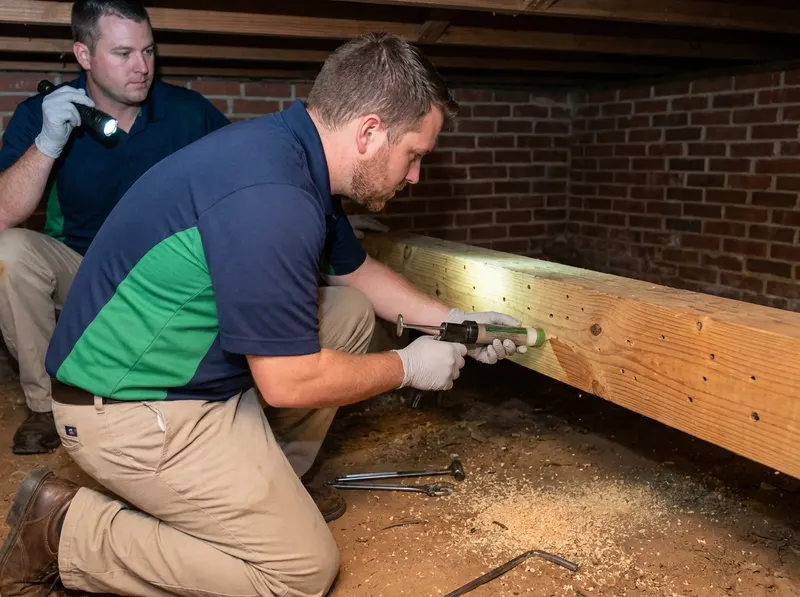
Remediation of powderpost beetles (Lyctinae) and larger wood-boring beetles (Cerambycidae and Buprestidae) depends on identifying active larval activity rather than historical emergence holes. Powderpost beetles produce an ultra-fine, flour-like dust known as frass, which falls from 1/32-inch to 1/16-inch pinholes in seasoned hardwoods and softwoods. In historic Dilworth bungalows and Myers Park estates built with unsealed, original floor joists, relative indoor humidity during Piedmont summers often spikes above 70%, sustaining wood moisture levels above 14% where beetle larvae thrive. Borate salt solutions (disodium octaborate tetrahydrate) applied directly to bare wood penetrate the outer 1/4 to 3/4 inch of the timber, neutralizing larvae as they chew their way toward the surface to pupate.
Decision guidance relies on wood condition and accessible surface area. When crawlspace joists and subflooring show fresh frass deposits, localized liquid borate surface applications provide permanent mineral protection because the salts do not decompose or off-gas over time. If an infestation involves painted, stained, or finished timber inside finished areas like Plaza Midwood renovated attics, topical liquid borate will not penetrate the varnish barrier. In those instances, remediation requires either deep micro-injection into active emergence channels or removal of the top finish to allow direct chemical absorption. Whole-structure fumigation represents an alternative for severe widespread infestations, but localized borate saturation eliminates the expense, property evacuation, and chemical lingering associated with structural tents when the damage remains isolated to crawlspaces or subfloors.
Effective remediation operates under explicit trade-offs between chemical treatment and moisture management. Applying borates kills active generations, but failing to lower wood moisture below 12% leaves un-penetrated timber cores susceptible to long-term re-infestation. Technicians pair localized liquid treatments with crawlspace vapor barrier assessment to address the Mecklenburg County soil dampness that feeds larval development. Localized chemical application preserves living areas without requiring families to vacate, confining active compounds to crawlspaces, wall cavities, and framing. Service inquiries route directly to operational dispatch at (980) 470-3059 without automated aggregator delays.
Every job gets a firm, written price after a free on-site visit.
Tell us about your wood-boring beetle and powderpost beetle remediation job in Charlotte and we'll send a clear, written quote, usually the same day.
 ClearZone Pest Control