Crawlspace moisture mitigation and vapor encapsulation in Charlotte, NC provides structural subfloor stabilization for crawl-foundation homes where persistent relative humidity routinely exceeds the critical 70%…
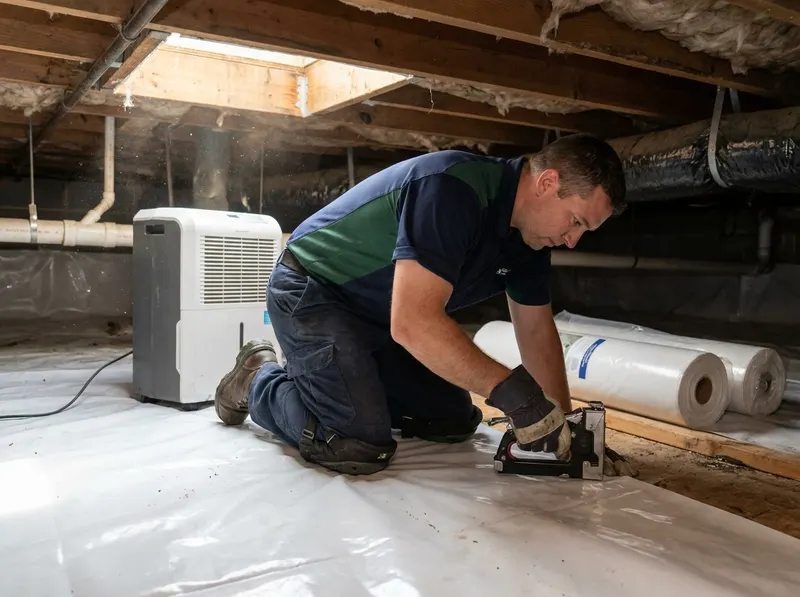
Crawlspace moisture mitigation and vapor encapsulation in Charlotte, NC provides structural subfloor stabilization for crawl-foundation homes where persistent relative humidity routinely exceeds the critical 70% threshold. In Piedmont regions like Mecklenburg County, sustained summer dew points saturate porous foundation vents, trapping airborne vapor directly against pine floor joists and subfloors. Wood-destroying organisms such as eastern subterranean termites (*Reticulitermes flavipes*) and wood-decay fungi require wood moisture content above 18% to establish colonies, while German and American cockroaches exploit crawlspace condensation pans and plumbing penetrations as entry zones. Vapor encapsulation stops capillary rise from soil, locking foundation moisture out of the interior living perimeter.
The installation process follows four structural stages. First, technicians clear foundation debris, rake ground soil level, and inspect joists with pin-type moisture meters. Second, unconditioned passive foundation vents are sealed with rigid high-density foam insulation blocks to eliminate exterior humid air intake. Third, an antimicrobial 12-mil or 20-mil woven poly vapor barrier is anchored to ground soil and mechanically pinned 6 to 12 inches up the masonry foundation walls, leaving an intentional 3-inch termite inspection gap required by North Carolina building code. Fourth, technicians install dedicated crawlspace dehumidifiers (sized between 70 to 110 pints per day) tied into automated gravity drains or condensate pumps to stabilize wood moisture levels continuously below 14%.
Selecting crawlspace encapsulation versus standalone localized insect treatments depends on structural foundation metrics. Localized perimeter chemical barriers deter tunneling termites temporarily, yet failing to eliminate the underlying moisture reservoir allows wood decay and recurrent re-infestations across neighborhoods like Dilworth, Myers Park, and Plaza Midwood. Full encapsulation demands higher initial outlay, whereas simple 6-mil dirt cover leaves exposed masonry seams and unconditioned vent drafts that fail within 18 months under humid summer rain cycles. Homes experiencing musty indoor air, cupping hardwood floorboards, and recurring pest sightings require a closed subfloor system to preserve domestic floor framing intact.
Every job gets a firm, written price after a free on-site visit.
Tell us about your crawlspace moisture mitigation and vapor encapsulation job in Charlotte and we'll send a clear, written quote, usually the same day.
 ClearZone Pest Control