Residential insect pressure across Mecklenburg County accelerates from April through October, driven by persistent relative humidity exceeding 70 percent and an expansive tree canopy. In older historic crawl spaces…
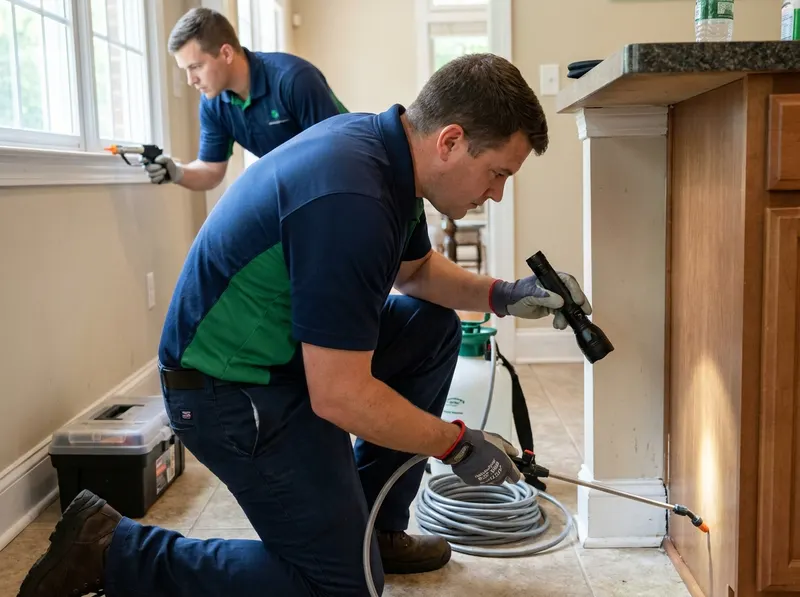
Residential insect pressure across Mecklenburg County accelerates from April through October, driven by persistent relative humidity exceeding 70 percent and an expansive tree canopy. In older historic crawl spaces throughout Dilworth and Myers Park, subterranean moisture frequently drives American cockroaches (Periplaneta americana) upward through weep holes, foundation vents, and subflooring penetrations. In dense multi-unit properties and renovated bungalows across Plaza Midwood, German cockroaches (Blattella germanica) nest primarily within appliance compressor voids, wall cavities, and under-sink plumbing collars. These two distinct pests require non-overlapping management protocols: broadcast repellent sprays fail by scattering German infestations deeper into dry-wall bays, while exterior structural exclusions resolve large peri-domestic cockroach incursions before indoor breeding colonies establish.
Decision-fit for remediation hinges on species biology and nest localization. When visible crawling insects are restricted to exterior entries, basements, or crawl spaces, a multi-zone perimeter application utilizing hydrophobic non-repellent liquid barriers repels intrusion without tracking active residues into human living spaces. If indoor sightings occur during daylight hours in kitchens or bathrooms, German cockroach populations require systematic gel-bait placements paired with juvenile hormone analogues (insect growth regulators) that arrest nymphal molting cycles. The primary operational trade-off centers on non-interference: structural gel baits require 14 to 21 days to complete secondary horizontal transfer throughout the aggregation, precluding the concurrent use of household aerosol insecticides that contaminate bait matrices.
Treatment execution follows four concrete stages. Step 1: Technicians complete a thermal and visual inspection to identify harborage points along foundation footings, under counter perimeters, and behind motor housing units. Step 2: High-potency abamectin or indoxacarb gel baits are deployed in measured, pinhead-sized placements inside mechanical voids inaccessible to children and domestic pets. Step 3: An exterior non-repellent perimeter band is applied 3 feet up the exterior brick or siding and 3 feet out onto the soil line, engineered specifically to resist Piedmont clay moisture retention and seasonal rain wash-off. Step 4: Physical insect monitoring stations are placed adjacent to critical moisture sources to verify population decline over a 30-day post-application window.
Every job gets a firm, written price after a free on-site visit.
Tell us about your targeted cockroach and crawling insect remediation job in Charlotte and we'll send a clear, written quote, usually the same day.
 ClearZone Pest Control